Amble: designing care for an ageing society in 2065
Amble asks a hard question for an ageing society: how can future care help people stay independent at home without making them dependent on the very systems meant to support them? Over seven months I led a four-person team through foresight research for Rodd Design Studio and the Winchester School of Art, arriving at a 2065 care service whose vehicle is a living, bioengineered plant system that supports older adults through presence rather than instruction. The work was exhibited at the London Design Festival.
A speculative foresight project, not a shipped product. Amble was a live brief from Rodd Design Studio, run through the Global Smart Lab at the Winchester School of Art, University of Southampton. I led a four-person multidisciplinary team across seven months of research and design. The concept is deliberately set in 2065, so the imagery and features here are research-grounded provocations, not a product roadmap. The work was exhibited at the London Design Festival in September 2025.

Amble was shown to the public as part of Tender Interbeing: The Future of Design with Empathy.
A seven-month research project, selected for one of the world's leading design festivals and exhibited alongside industry.
Technology for ageing is built to monitor, not to care
Most technology designed for later life focuses on efficiency and surveillance. It tracks, reminds, and alerts. For the people using it, that often feels intrusive and faintly medical, a constant signal that they are being managed rather than supported.
The research literature has been moving the other way for years, towards empathetic, multisensory, human-centred environments. Yet the products on the shelf still treat an ageing person as a system to be optimised.
Design the care service, not the device
Rodd Design Studio set the team a foresight brief through the Winchester School of Art's Global Smart Lab: explore how an ageing society might live, and be cared for, in 2065.
The forty-year horizon freed the work from today's devices and let us design at the level of the whole care service: the relationships between an older person and their family, carers, healthcare providers, and community, and how a future service could hold all of them together without making the person at its centre feel managed.
Independence is held by a whole system, not a device
Treating this as a service, not a gadget, meant mapping everyone who shapes whether an older person stays independent at home, and designing Amble to support those relationships rather than replace them.
The person at the centre. Independence and dignity, never the feeling of being managed.
Reassurance and connection from a distance, without tipping into surveillance.
A lighter coordination load and clearer signals about what actually needs attention.
Earlier, gentler signals that surface needs before they become crises.
Prevention that helps people stay out of formal care for longer.
Belonging and participation as part of care, not an afterthought to it.
Infrastructure that stays in the background and earns its place quietly.
Leading a multidisciplinary team through ambiguity
I was project lead for a team of four designers and researchers, working to a real client brief over seven months. On a speculative project the hardest thing to hold is the frame. With no product to anchor decisions, a foresight project can drift into either science fiction or a thinly disguised version of the present.
My job was to keep the team honest: every imaginative leap had to trace back to a research insight or a piece of evidence. I set the research approach, ran the synthesis, steered two significant changes of direction, and shaped how the final concept was communicated and exhibited.
Two ideas we built and set aside
The plant system was not the first answer. It was the third. The two concepts the team built and abandoned were not wasted work, they were how we found the real brief.
Interactive Brain Gym
Memory preservation and cognitive exercises, designed with dementia in mind, to keep the brain active in later life.
Solving for one condition narrowed the brief to a clinical problem. The research kept pointing somewhere broader: emotional wellbeing, not just memory.
Home Companion Robot
A device to track, nudge, detect, and assist across the home, a single assistant for everything.
It worked on paper and felt wrong in practice. A robot is another screen, another thing demanding attention, the opposite of the calm the research asked for.
Amble
A living, bioengineered plant system. Care delivered through presence and ambient cues, not commands.
A plant is already emotionally legible. It does not demand interaction, it shares the space. That let us design support that is ambient, sensory, and quiet.
Research-through-design, end to end
A research-through-design method, anchored in 2065
We adopted a research-through-design methodology, combining speculative design with a literature review and primary research. Setting the concept forty years out was a deliberate device. It moved conversations away from "what gadget would you buy" and towards "what should later life feel like", which is where the useful insight lives.
Focus groups across two generations
The research used focus groups with two very different cohorts: two groups of younger adults aged 20 to 40 in Winchester, who would actually be the ageing population of 2065, and a gathering of fifteen older adults aged 50 to 80 in Southampton, reached through local churches and community groups. The older-adult session was run as a relaxed afternoon with refreshments and a reminiscence game, not a clinical interview, so people spoke openly about retirement, care, and technology.
Synthesising lived experience against the evidence
I led the synthesis, triangulating what participants told us against an evidence base spanning environmental psychology, synthetic biology, and inclusive design. Where a focus-group insight and a research finding agreed, we had a firm design principle. Where they diverged, we had a question worth designing into the concept.
From insight to a five-domain system
The concept resolved into five interconnected domains, from decentralised ambient intelligence to a wearable air-filtering extension. Each domain answered a specific, evidenced need rather than showcasing a technology. The test for every feature was the same: does this support independence, or quietly erode it?
A brand that reads as living, not technical
Branding was treated as part of the design argument, not decoration. Every choice, the serif wordmark, the earth-toned palette, the voice that speaks as a companion rather than an assistant, was made to convince people that Amble is a living presence and not another device.
Exhibited at the London Design Festival
The work was selected for the London Design Festival in September 2025, exhibited as part of "Tender Interbeing: The Future of Design with Empathy" at the White City Warehouse. Translating seven months of research into a public exhibition forced a final round of editing: what does a visitor need to understand in ninety seconds?
Two generations, one shared need
We spoke to the people who will be old in 2065 and the people who are ageing now. They described later life very differently, but they asked design for the same thing: support that does not demand attention.
- They pictured later life as a time to explore, learn, and travel, not decline, while accepting they would likely face reduced mobility or chronic health conditions.
- They were openly frustrated with today's assistant technology. Alexa and phone-based AI were described as prompt-based and transactional, passive tools that demand constant input to be useful.
- They wanted intelligence that is ambient and sensory, that adapts quietly instead of waiting to be asked, and they responded to Amble being a real plant rather than a device.
- Many described retirement as involuntary, brought on by illness or burnout, and spoke about the loss of identity and structure that followed.
- They held tightly to small acts of independence, shopping, gardening, birdwatching, as markers of dignity and a connection to the outside world.
- Their message to assistive technology was clear: support the routine, never replace it. A system that does everything for you takes something away.
"Plants can give emotional support in a way that animals or humans can't."
Focus group · younger adults
"I retired through ill health, so I didn't have a choice. It was taken away from me."
Focus group · older adults
"I still like to do my own shopping. I want to go. I don't like having a delivery."
Focus group · older adults
Amble: a living system with five domains
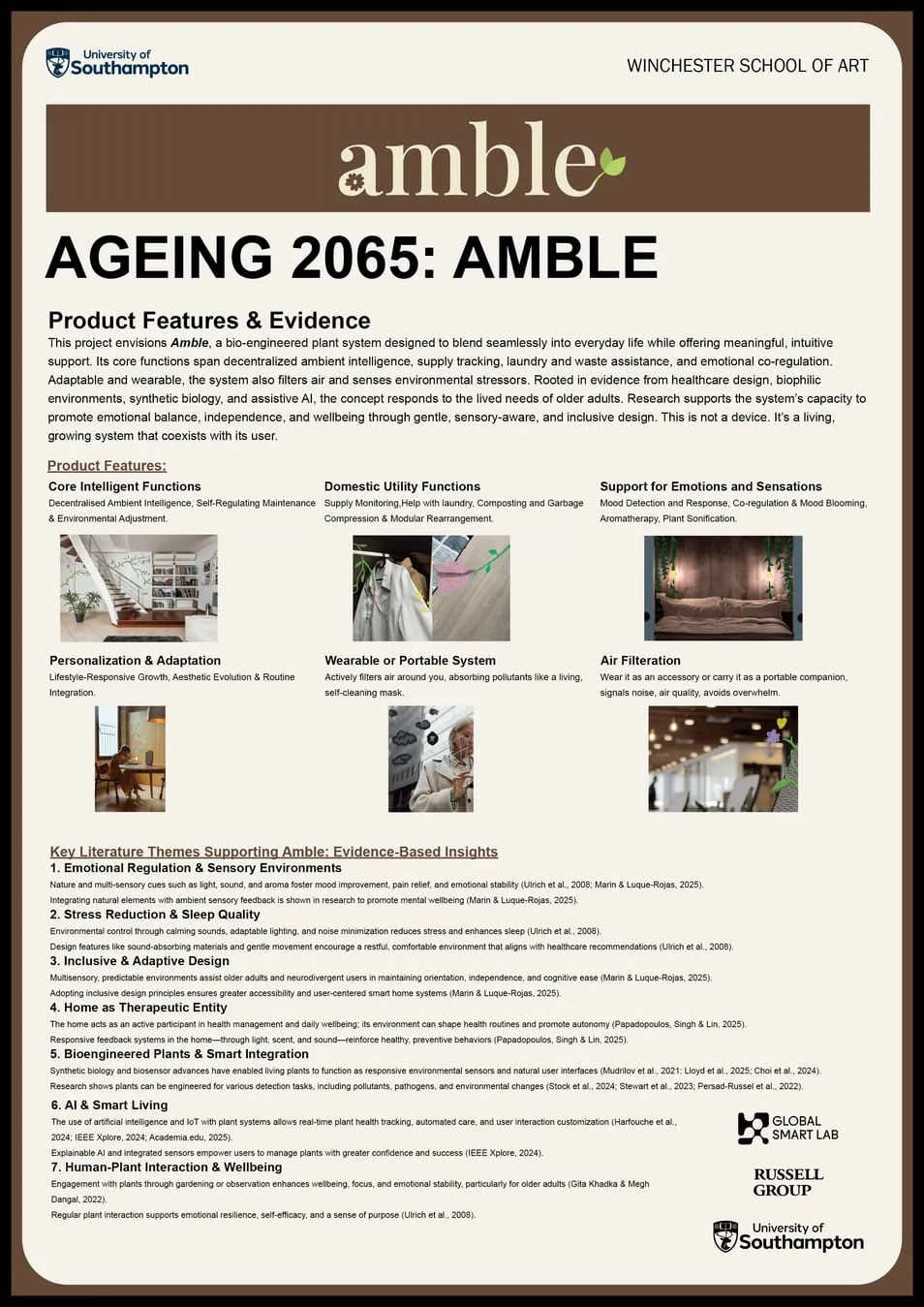
Amble is a bioengineered plant system that coexists with the people it supports. It senses, adapts, and responds through light, scent, sound, and growth, rather than screens and notifications. The concept is organised into five interconnected domains.
Core intelligent functions
Decentralised ambient intelligence. The system self-regulates its own maintenance and adjusts the home environment, with no central controller and no command to issue.
Domestic utility
Quiet help with everyday tasks: supply monitoring, composting, laundry support, and modular rearrangement of the space as needs change over time.
Emotional & sensory support
Mood detection met with response: aromatherapy, sound feedback, bioluminescence, and "mood blooming", the plant co-regulating alongside the person.
Personalisation & adaptation
The system grows with its resident. Its form and rhythm evolve to match an individual lifestyle and routine, rather than imposing one.
Wearable extension
A portable, air-filtering module that absorbs pollutants and tracks air quality, carrying Amble’s presence beyond the walls of the home.
Care, woven into the home
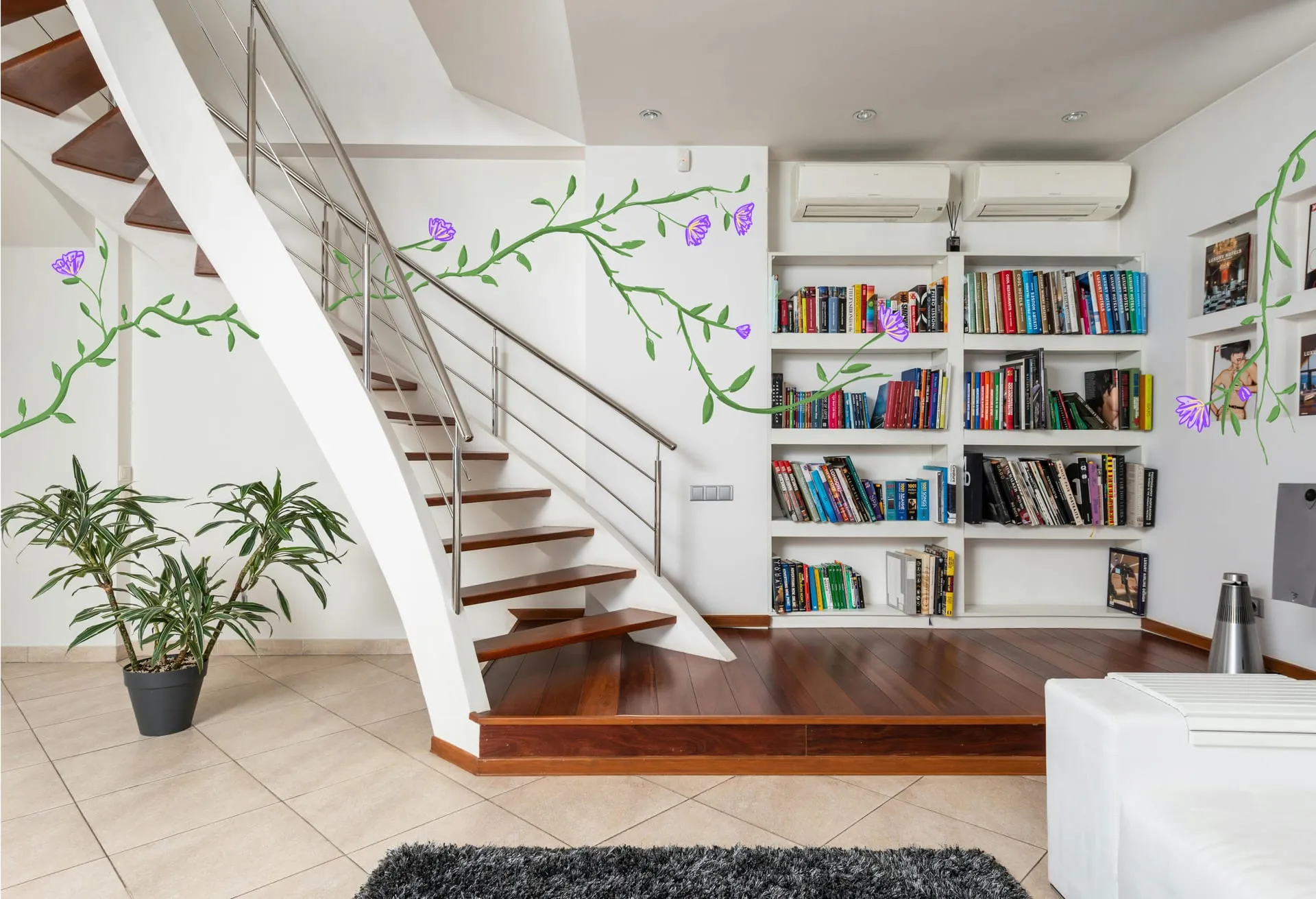
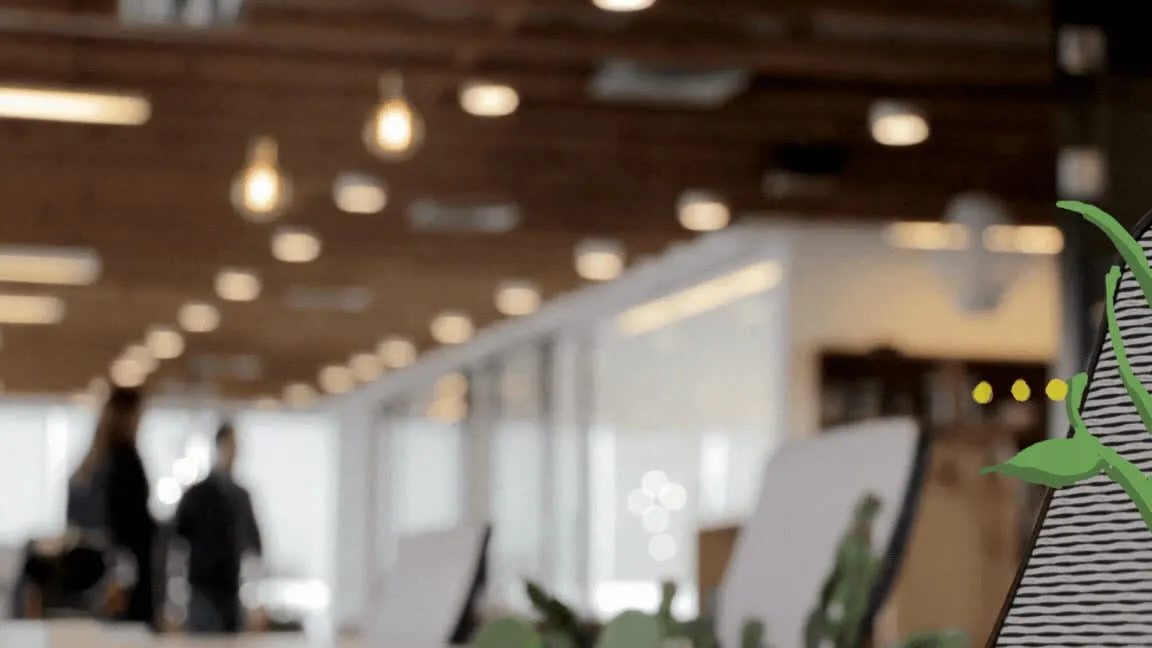
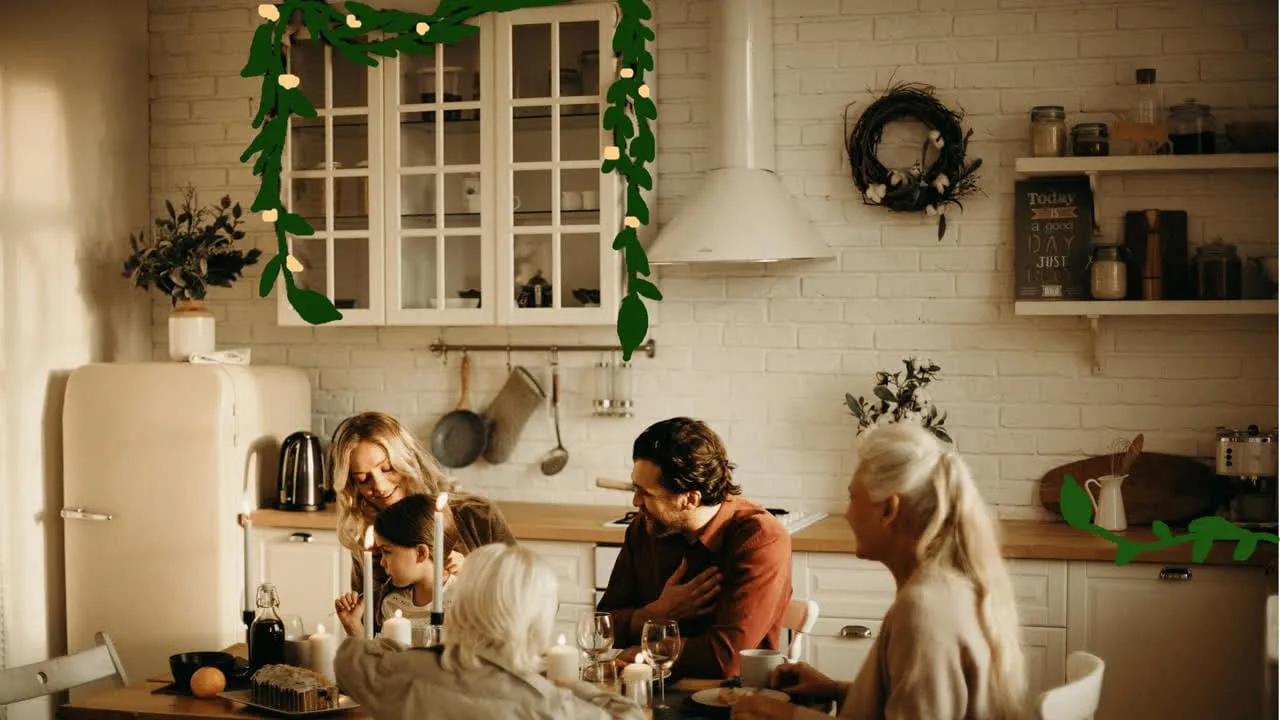
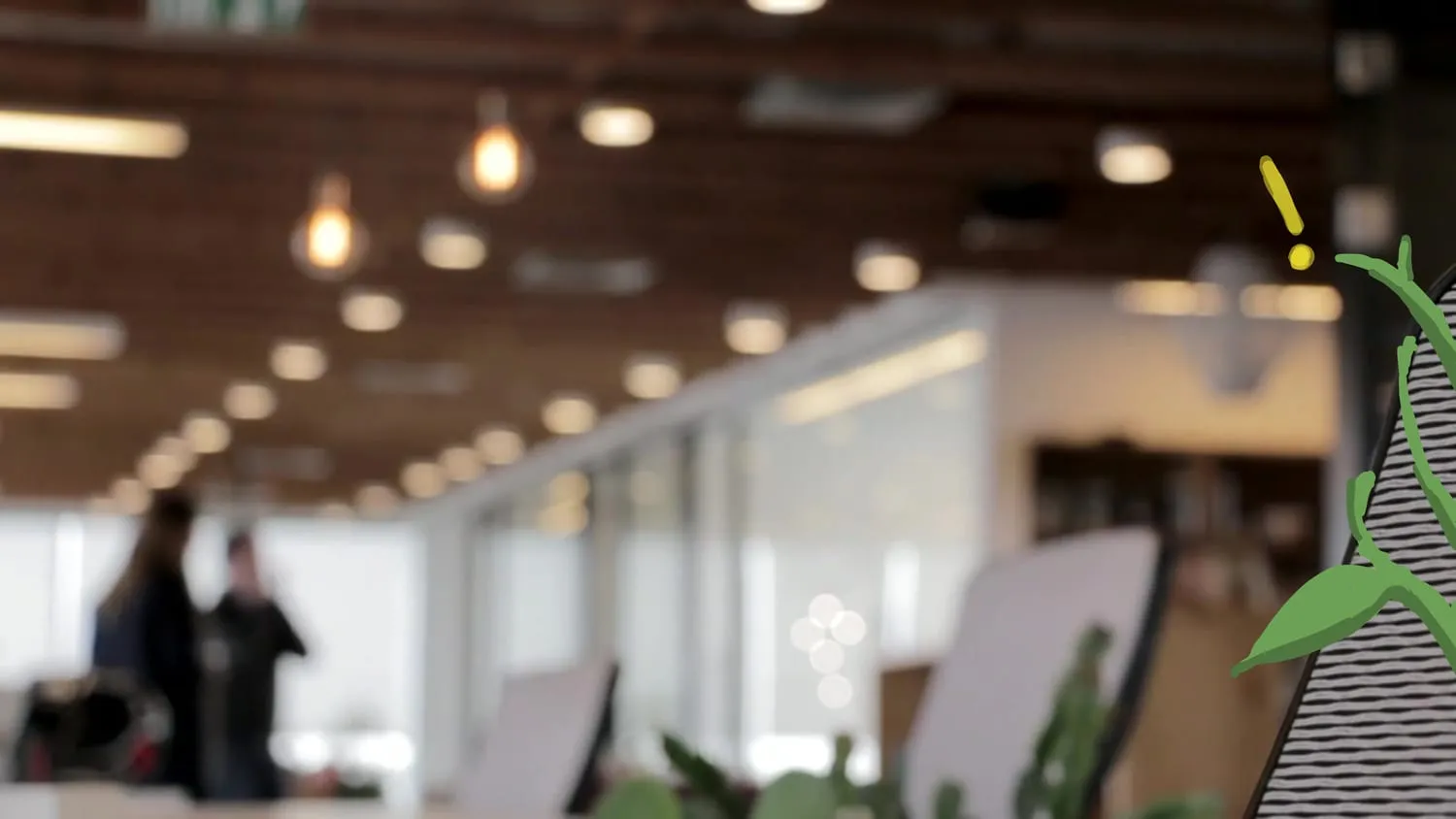
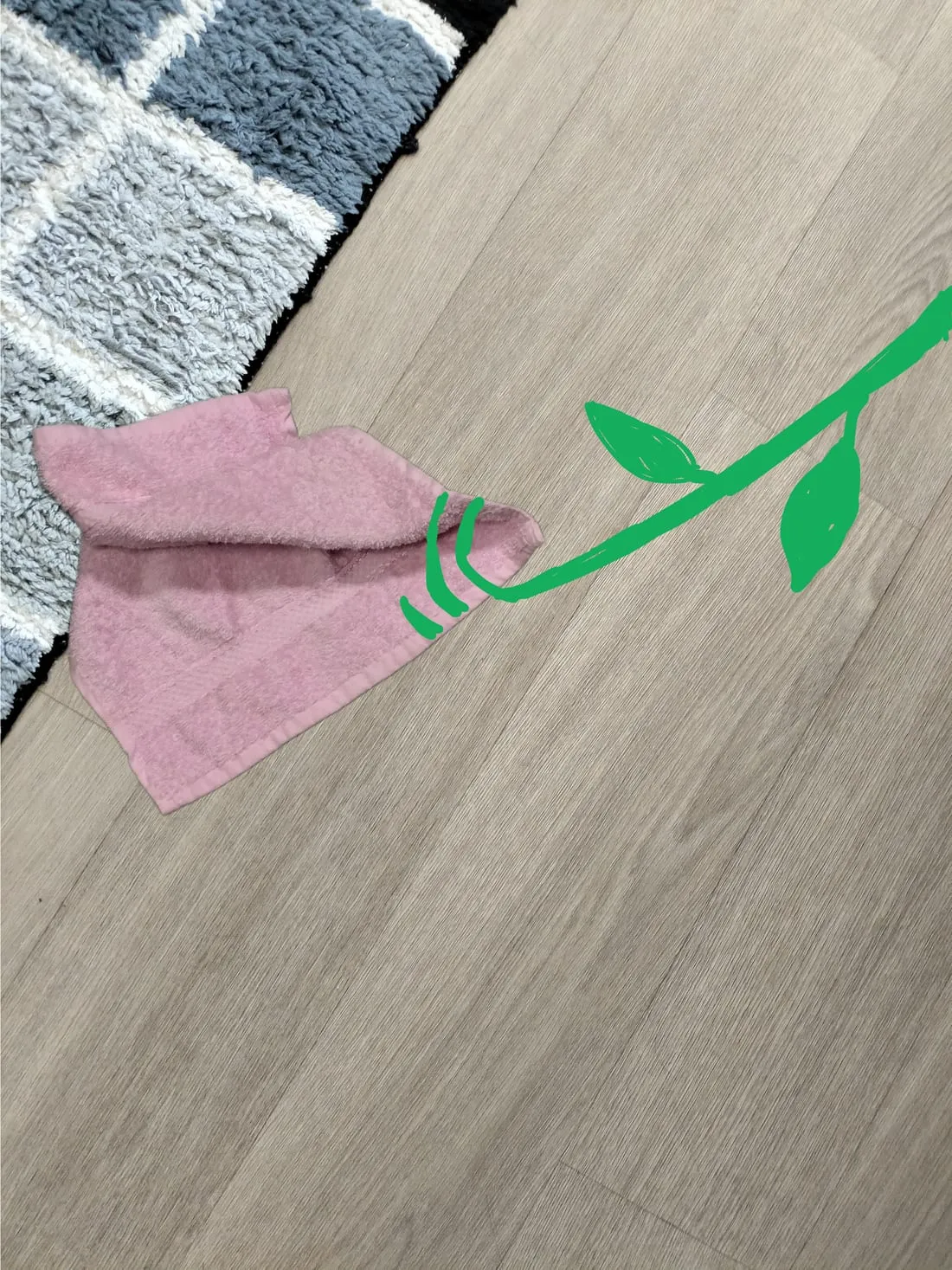
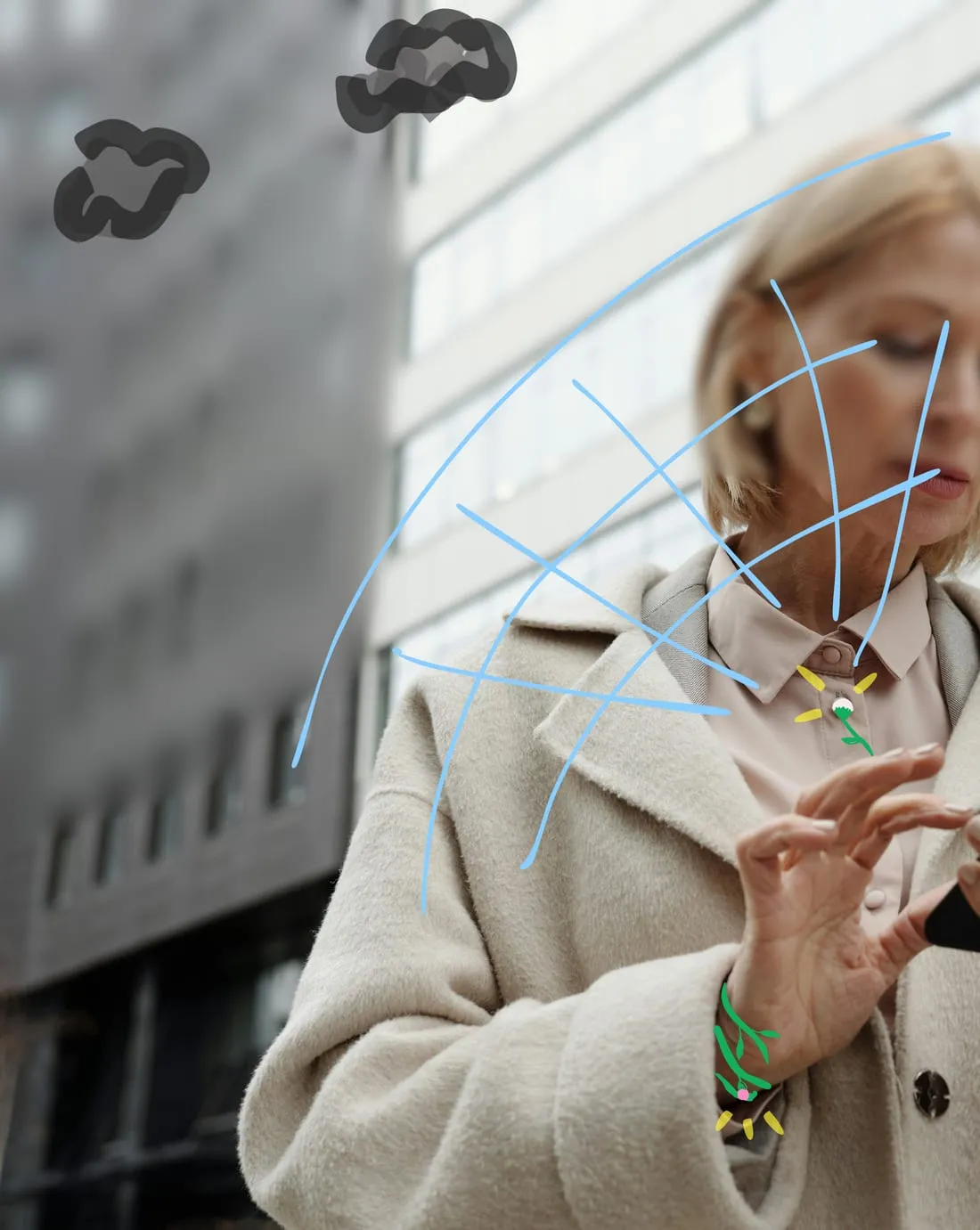
The team visualised Amble through a brand film and a set of concept scenes, hand-drawn growth layered over real domestic spaces. The illustration style was a deliberate choice: warm and sketched, never the cold render of a tech product.
A brand that feels alive, not engineered
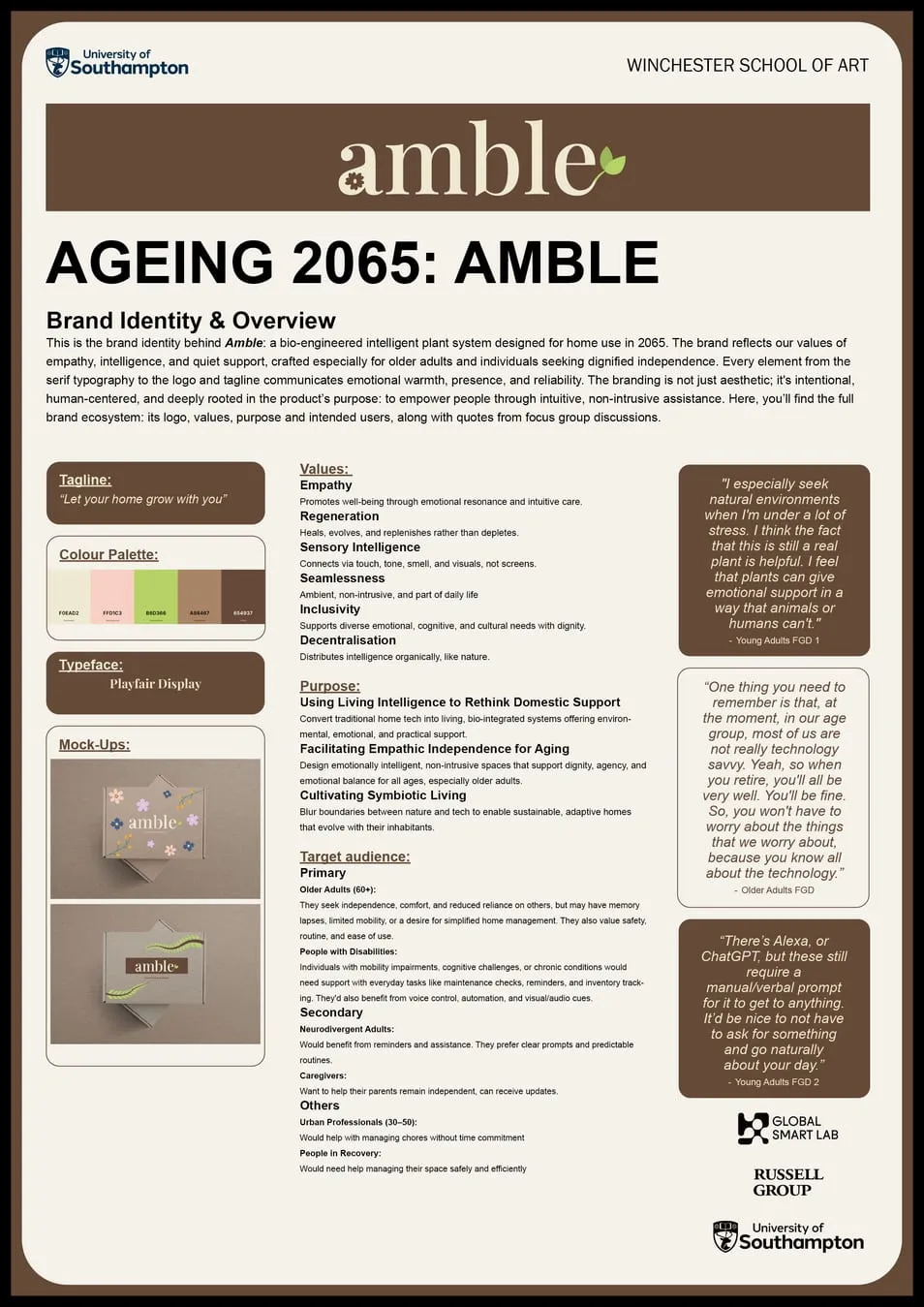
The brand had one job: convince people that Amble is a living companion, not a gadget. Every decision, from the typeface to the tone of voice, was grounded in research on how older adults read, trust, and feel at ease.

A Playfair Display wordmark, lowercase for approachability. A flower grows from the "a", a leaf sprouts from the "e", marking Amble's dual nature as both biological and intelligent.
Muted earth tones, chosen for the calm familiarity and visual ease that research links to older adults' preferences.
Typography with a reason
Playfair Display, a modern serif, paired with the geometric sans Poppins. The pairing was evidence-led: studies show older adults read serif type more comfortably at larger sizes, and that typefaces themselves carry personality, in this case sincerity and calm.
A voice that supports, not instructs
Amble's brand voice speaks as a presence, not an assistant. The tone is warm, calm, gentle, and mindful, helpful but never insistent, offering reassurance in moments of uncertainty without ever overwhelming the person it is speaking to.
Trust built through warmth and approachability.
Systems that grow, adapt, and replenish.
Communicating through light, scent, and sound.
Intelligence felt, not noticed.
Support distributed gently across the space.
Designed for the full range of later-life needs.
Let your home grow with you.
Amble · brand tagline
From research project to public exhibition
Being accepted into "Tender Interbeing: The Future of Design with Empathy" meant the project left the studio and met a public audience of designers and industry. Translating seven months of research into an exhibition was a design problem of its own. The two posters below carry the full argument, the concept, the evidence, and the rationale, condensed to what a visitor can absorb in a single pass.
What leading a foresight project taught me
The discipline of speculative design is not imagination, it is restraint. The easy version of this brief is a beautiful film about plants in 2065. The useful version traces every idea back to evidence. As project lead, most of my work was holding that line, asking the team, repeatedly, which research insight a given feature actually answered. The concept is bold, but nothing in it is invented for effect.
Leading a multidisciplinary team through ambiguity was the real lesson. For seven months there was no screen to review, no flow to test, no obvious sign of progress. Keeping four people aligned and confident without those anchors meant being clear about the questions we were answering, even as the answers kept changing. Two of our concepts were abandoned. Naming that as progress, not failure, was part of the job.
Team Gen2065: Nysargi Giridhar Karnam, Rhea D'Silva, Smiti Baraskar, and Sayantan Dutta. A Global Smart Lab Live Project at the Winchester School of Art, University of Southampton, with Rodd Design Studio. Supervised by Dr Shan Wang and Dr Angelina Pan, with creative guidance from Ben Davies.
In partnership with